
Introduction
Marriage is both a deeply personal commitment and a legal institution recognized by the State. But what happens when one spouse believes, on religious grounds, that marriage can never be dissolved, while the other spouse seeks a divorce through the courts?
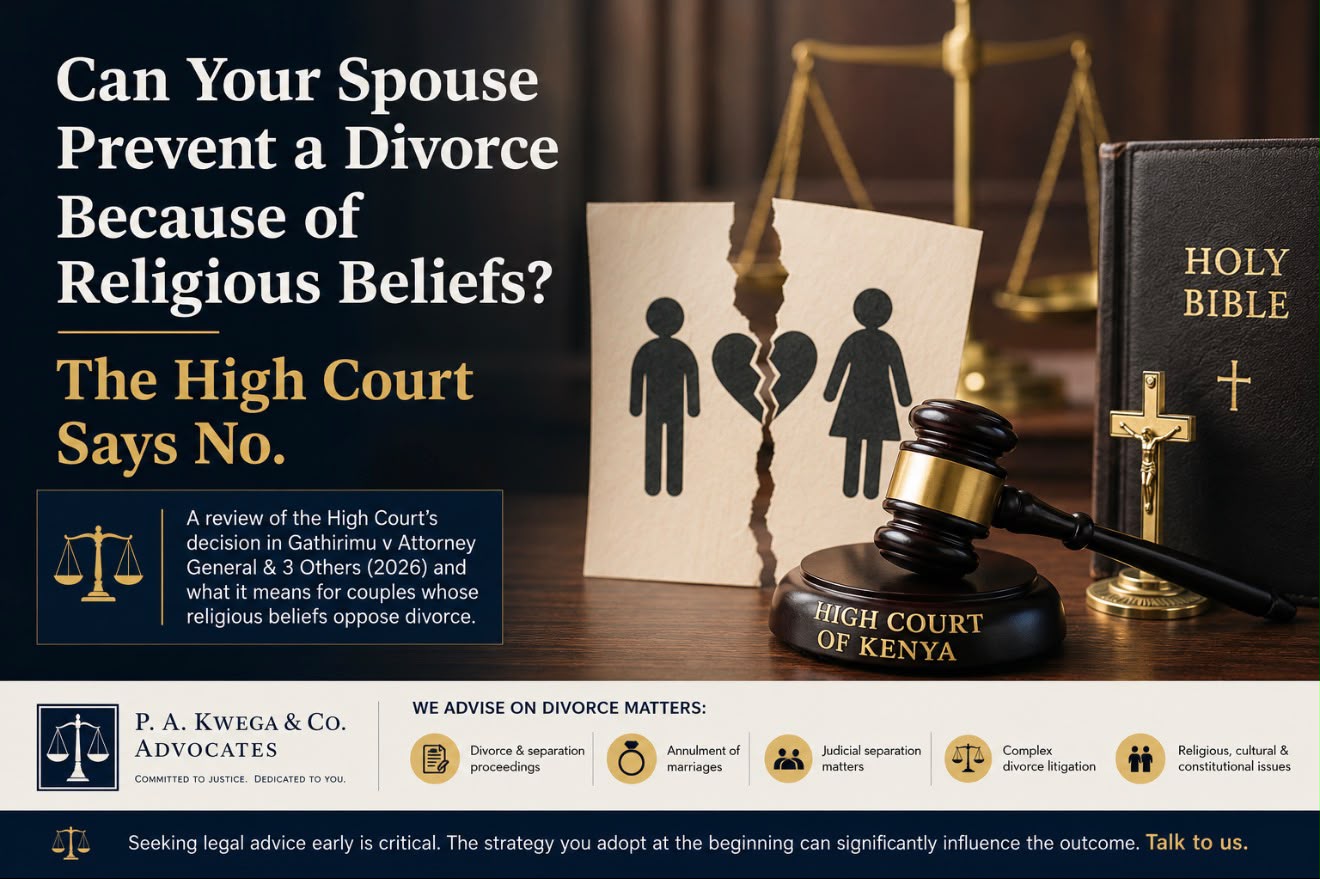
This question came before the High Court in Gathirimu v Attorney General & 3 Others, [2026] KEHC 8539 (KLR) where a Catholic husband challenged the constitutionality of Kenya’s divorce laws after his wife filed divorce proceedings.
The Court was asked to determine whether freedom of religion can prevent a spouse from seeking a civil divorce and whether the Marriage Act discriminates against Catholics by failing to recognize Catholic Canon Law.
Lady Justice R.E Aburili firmly answered both questions in the negative.
Background
The Petitioner and his wife celebrated a Catholic marriage in August 2019.
In March 2023, the wife filed divorce proceedings before the Chief Magistrate’s Court.
The Petitioner, a practising Catholic, opposed the divorce and filed a constitutional petition arguing that:
- Catholic marriages are sacramentally indissoluble.
- Participation in divorce proceedings violated his freedom of religion.
- Parliament failed to recognize Catholic Canon Law as required by Article 45(4) of the Constitution.
- The Marriage Act discriminates against Catholics while accommodating Islamic personal law.
- Catholic marriage disputes should be determined by Church tribunals rather than civil courts.
Issues Before the Court
The Court identified four key issues:
- Whether the Marriage Act, 2014 was enacted without adequate public participation.
- Whether Sections 65, 66 and 73 of the Marriage Act violate freedom of religion and conscience by permitting divorce.
- Whether the Act discriminates against Catholics by recognizing Islamic personal law while omitting Catholic Canon Law.
- Whether the Petitioner was entitled to the constitutional remedies sought.
What Did the Court Decide?
-
The Marriage Act Was Properly Enacted
The Court rejected the argument that Parliament failed to conduct public participation.
Evidence showed that Parliament invited views from the public and stakeholders through newspaper advertisements and considered memoranda from interested groups before passing the legislation.
Importantly, the Court held that public participation does not require Parliament to adopt every view presented by every stakeholder.
The fact that a particular religious denomination’s proposals were not incorporated into the final legislation does not render the law unconstitutional.
-
Freedom of Religion Does Not Prevent a Spouse from Seeking Divorce
This was the central issue in the case. The Court acknowledged that Catholics may sincerely believe that marriage is indissoluble. However, it held that the Constitution protects religious freedom without allowing religious doctrine to override civil law.
The Court noted that Sections 65 and 66 of the Marriage Act provide that a spouse may petition for divorce. The use of the word “may” means the law does not compel anyone to divorce. Rather, it simply provides an option for a spouse who wishes to leave a marriage that has irretrievably broken down.
Accordingly, a spouse remains free to follow their religious beliefs and refrain from seeking divorce, but cannot prevent another spouse from exercising rights granted by law.
-
There Is No Constitutional Right to Remain Married Against a Spouse’s Wishes
The Court emphasized that Article 45 of the Constitution protects:
- The right to marry.
- Equal rights during marriage.
- Equal rights upon the dissolution of marriage.
The Constitution therefore contemplates that marriages may end.
The Court rejected the Petitioner’s argument that there exists a constitutional “right to stay married” and observed that the Constitution does not guarantee a right to stop another spouse from obtaining a divorce.
-
Religious Doctrine Cannot Override Civil Law
One of the most important principles emerging from the judgment is the distinction between:
- Marriage as a religious sacrament; and
- Marriage as a civil institution regulated by the State.
The Court held that while churches may regulate spiritual and doctrinal matters, marriage remains a legal relationship recognized and governed by Kenyan law.
The State therefore retains authority to regulate marriage, divorce and family relations in a manner consistent with constitutional values. -
The Court Protected Individual Autonomy and Human Dignity
The Court observed that accepting the Petitioner’s argument would effectively force a spouse to remain in a failed marriage solely because of the religious beliefs of the other spouse.
According to the Court, human dignity includes personal autonomy and the ability to leave relationships that have irretrievably broken down.
The law cannot permit one spouse’s religious convictions to permanently bind another spouse to a marriage against their will. -
The Marriage Act Does Not Discriminate Against Catholics
The Petitioner argued that the Marriage Act accommodates Islamic personal law while failing to recognize Catholic Canon Law. The Court rejected this argument.
It held that the Marriage Act creates a neutral legal framework applicable to all citizens and that allowing Catholics to be exempted from divorce laws would itself create unequal treatment under the law.
The Court further emphasized that equality requires citizens to enjoy equal access to legal remedies, regardless of whether they choose to exercise those remedies.
Key Principles from the Decision
This judgment establishes several important principles:
-
Religious Freedom Is Protected, but Not Absolute
The Constitution protects freedom of religion, but religious beliefs cannot be used to invalidate laws enacted for legitimate public purposes.
-
Marriage Has Both Religious and Civil Dimensions
A marriage may be religiously significant, but once recognized under Kenyan law it also acquires legal consequences governed by the State.
-
A Spouse Cannot Be Forced to Remain in a Broken Marriage
The constitutional values of dignity, equality and autonomy support the availability of lawful mechanisms for ending irretrievably broken marriages.
-
Parliament Is the Proper Forum for Legislative Reform
If religious groups wish to change the legal framework governing marriage and divorce, their remedy lies in legislative reform through Parliament rather than constitutional invalidation of existing laws.
Why This Case Matters
- This decision is significant because it clarifies the relationship between religious freedom and family law in Kenya.
- The judgment confirms that while individuals remain free to practise and adhere to their religious beliefs, those beliefs cannot prevent another spouse from exercising rights granted by the Constitution and the Marriage Act.
- For family law practitioners, the case reinforces the principle that the right to freedom of religion cannot be invoked to defeat a spouse’s right to seek dissolution of a marriage that has irretrievably broken down.
Conclusion
The High Court ultimately upheld the constitutionality of the Marriage Act and dismissed the petition.
In doing so, it reaffirmed a fundamental constitutional principle: religious beliefs are entitled to respect and protection, but they cannot be used to deny another person access to lawful civil remedies.
The decision serves as an important reminder that while faith may guide personal choices, marriage remains a legal institution regulated by the Constitution and the laws of Kenya.
At P. A. Kwega & Co. Advocates, we advise and represent clients in:
- Divorce and separation proceedings
- Annulment of marriages
- Judicial separation matters
- Complex and high-conflict divorce litigation
- Divorce matters involving religious, cultural and constitutional considerations
Whether you are contemplating divorce, responding to divorce proceedings, or seeking to protect your rights during the dissolution of a marriage, obtaining legal advice early is critical. The strategy you adopt at the beginning can significantly influence the outcome.
Talk to us.






 Call or Chat with us