-
When can I file for divorce in Kenya?
A person who is legally married may petition the court for dissolution of the marriage where the applicable legal grounds for divorce have arisen. The grounds and procedure may differ depending on whether the marriage is Christian, civil, customary, Hindu or Islamic.
-
Can I get divorced before three years of marriage?
Yes. The three-year restriction previously applicable to civil marriages was declared unconstitutional by the High Court. A spouse does not necessarily have to remain in a marriage for three years before seeking divorce.
If your marriage has lasted less than three years, it is advisable to obtain legal advice on the applicable procedure before filing your petition. -
Do I need to go to court to get divorced in Kenya?
Yes. A marriage is not legally dissolved merely because spouses have separated, signed an agreement, or stopped living together.
Christian, civil, customary and Hindu marriages are generally dissolved through the courts in accordance with the Marriage Act. Islamic marriages are dissolved in accordance with Islamic law through the Kadhis’ Courts where the constitutional requirements for their jurisdiction are satisfied. -
What documents do I need to file for divorce?
The documents required will depend on the circumstances of your case, but ordinarily include:
- a Petition for dissolution of marriage;
- a Verifying Affidavit;
- an authenticated copy of the Marriage Certificate;
- a list of witnesses, where applicable;
- witness statements, where applicable; and
- copies of documents or other evidence that will be relied upon.
As your advocates, may recommend additional documents depending on the grounds for divorce and whether there are other issues arising from the marriage.
-
What is the divorce process in Kenya?
A divorce ordinarily begins with the filing of a Petition for dissolution of marriage.
The Petition and accompanying documents are then served upon the other spouse, who has an opportunity to enter appearance and, if they wish, file an Answer and/or Cross-Petition.
Once the pleadings are in order, the matter proceeds through the court process and ultimately to hearing or determination.
Where the court is satisfied that the legal requirements for dissolution have been established, it will dissolve the marriage. A Decree Nisi is issued and, ordinarily after thirty days, a party may apply for the Decree Absolute confirming the final dissolution of the marriage.
The exact process and duration will depend on whether the divorce is defended or undefended and the circumstances of the particular case. -
What are the grounds for divorce in Kenya?
The applicable grounds depend on the type of marriage.
For Christian and civil marriages, common grounds include:- adultery;
- cruelty, whether physical or mental;
- desertion;
- exceptional depravity; and
- irretrievable breakdown of the marriage.
The facts of each marriage must be considered carefully to determine which ground or grounds are supported by the evidence.
-
What does “irretrievable breakdown of marriage” mean?
A marriage has irretrievably broken down where the marital relationship has deteriorated to such an extent that it can no longer reasonably be restored.
The court considers the circumstances of each case, including matters such as prolonged separation, persistent conflict, neglect of marital obligations and other conduct demonstrating that the marriage has effectively come to an end. -
What is a Divorce Petition?
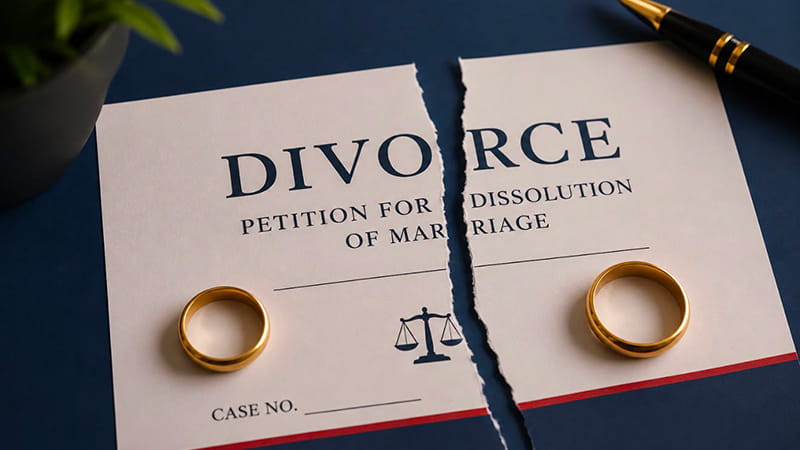
A Divorce Petition is the formal document filed in court asking for the dissolution of a marriage.
It identifies the parties and their marriage, sets out the legal grounds relied upon, provides the material facts supporting those grounds and specifies the orders being sought from the court. -
What is the difference between separation and divorce?
Separation and divorce are different.
Separation allows spouses to live apart while remaining legally married. Divorce permanently dissolves the marriage.
A separated person therefore remains legally married unless and until the marriage is formally dissolved. -
Can my spouse refuse to give me a divorce?
Your spouse can oppose or defend the divorce proceedings, but their refusal to consent does not necessarily prevent the court from dissolving the marriage.
The court determines whether the legal grounds for divorce have been established based on the evidence presented before it. -
What is a contested divorce?
A contested or defended divorce occurs where one spouse disputes the divorce petition, the grounds relied upon, the allegations made, or the orders sought.
The Respondent may file an Answer and may also file a Cross-Petition setting out their own case against the Petitioner.
A contested divorce will ordinarily require greater preparation and may take longer to conclude than an undefended divorce. -
What is an undefended divorce?
An undefended divorce is one in which the Respondent does not file an Answer opposing the Petition.
However, the court must still be satisfied that the Petitioner has established a proper legal basis for dissolving the marriage. -
Can we get divorced by mutual consent in Kenya?
Spouses may both agree that their marriage should end. However, agreement between the spouses does not by itself dissolve the marriage.
A court process is still required and the court must be satisfied that the applicable legal requirements for dissolution have been met.
Where both spouses cooperate with the process and the Petition is not defended, the divorce may proceed as an undefended cause. -
Can we use mediation during divorce proceedings?
Yes, mediation and other forms of alternative dispute resolution can be useful in resolving issues arising from the breakdown of a marriage.
However, the dissolution of the marriage itself must ultimately be determined by the court. Issues such as children, maintenance and matrimonial property may require separate consideration and, where appropriate, negotiated settlements or mediation. -
Can I file for divorce online in Kenya?
Court documents may be electronically filed through the Judiciary’s e-filing system where that system is available.
However, uploading documents online does not itself amount to obtaining a divorce. The matter remains a court proceeding and the marriage is only legally dissolved once the court has made the appropriate orders and the final decree has been issued. -
Can I handle my divorce without a lawyer?
A person may represent themselves in divorce proceedings.
However, divorce proceedings involve legal grounds, procedural requirements, preparation and service of court documents and, in contested cases, evidentiary issues.
Legal representation is particularly advisable where the divorce is contested or where there are related disputes involving children, maintenance, matrimonial property, domestic violence, businesses or substantial assets. -
How much does a divorce cost in Kenya?
The cost depends on the circumstances and complexity of the case.
An undefended divorce will generally cost less than a heavily contested divorce because it requires fewer court appearances and less litigation.
Legal fees may also be affected by the complexity of the evidence, the number of applications required, the conduct of the other party and whether there are related disputes involving children, maintenance or matrimonial property.
We recommend obtaining a fee estimate after an initial consultation and assessment of your case. -
How long does a divorce take in Kenya?
There is no single timeframe applicable to every divorce.
The duration depends on factors such as whether the divorce is defended or undefended, how quickly the Respondent is served, whether interlocutory applications arise, court availability and the complexity of the dispute.
An undefended divorce will generally proceed more quickly than a contested divorce. -
What is a Decree Nisi?
A Decree Nisi is the initial decree issued following the court’s dissolution of the marriage.
It precedes the final decree confirming that the marriage has been legally dissolved. -
What is a Decree Absolute?
A Decree Absolute is the final decree confirming the dissolution of the marriage.
Under the Matrimonial Proceedings Rules, it ordinarily issues after the expiry of thirty days following the Decree Nisi, upon application by a party and unless the court directs otherwise.
Once the Decree Absolute is issued, the dissolution of the marriage is final. -
Where do I file for divorce in Kenya?
Divorce proceedings are generally commenced before a court with the appropriate jurisdiction under the Marriage Act.
The appropriate court will depend on the nature of the marriage and the circumstances of the case. Islamic matrimonial proceedings falling within the jurisdiction of the Kadhis’ Courts are commenced before a Kadhi’s Court.
A family lawyer can advise you on the appropriate court and filing station for your particular case. -
Can I remarry before my divorce is finalized?
If you are in a monogamous marriage, you should not contract another marriage while the existing marriage remains legally subsisting.
A separation, pending divorce case or Decree Nisi should not be treated as equivalent to a final divorce.
The legal position may differ for marriages that are potentially polygamous, including certain marriages celebrated under customary or Islamic law.
If you intend to remarry, obtain legal advice on your marital status before doing so. -
Can alcoholism or substance abuse be grounds for divorce?
Alcoholism or substance abuse is not necessarily, by itself, a standalone ground for divorce.
However, conduct associated with addiction may support recognised grounds such as cruelty or irretrievable breakdown of the marriage.
For example, violence, financial neglect, abandonment, emotional abuse or persistent destructive conduct arising from addiction may be relevant evidence before the court. -
What happens to the children after divorce?
Divorce does not automatically determine which parent gets custody of the children.
Questions concerning custody, care and control, access and maintenance are determined according to the best interests of the child under the Constitution and the Children Act.
Both parents continue to have parental responsibility for their children unless a court orders otherwise. -
Does the mother automatically get custody of young children?
No. There is no automatic rule that a mother must receive custody merely because a child is young.
The overriding consideration is always the best interests of the child. The court considers the individual circumstances of the child and each parent when determining custody, care and control. -
Can parents agree on custody and parenting arrangements?
Yes.
Parents can agree on arrangements concerning custody, care and control, access, education, healthcare, maintenance and other aspects of their children’s upbringing.
Where appropriate, these arrangements may be incorporated into a Parental Responsibility Agreement and/or adopted by the Children’s Court. -
What happens to matrimonial property after divorce?
Divorce does not automatically mean that matrimonial property is divided equally between the spouses.
Matrimonial property rights are governed principally by the Matrimonial Property Act, and the court considers each spouse’s contribution and the circumstances surrounding the acquisition and ownership of the property.
Property disputes may therefore require separate legal advice and proceedings. -
Can I claim maintenance from my spouse after separation or divorce?
Depending on the circumstances, a spouse may seek maintenance from the other spouse.
The court considers the particular circumstances of the parties, including their financial positions and other relevant factors, before determining whether maintenance should be awarded.
Child maintenance is separate from spousal maintenance and is determined according to the needs and best interests of the child and the responsibilities of both parents. -
Can I enter into a Separation Agreement with my spouse?
Yes.
For civil marriages, the Marriage Act expressly recognises agreements by spouses to live apart.
A properly prepared separation agreement can address matters arising during the separation. Where children or property are involved, legal advice is recommended to ensure that the agreement appropriately addresses those issues and is capable of being enforced where necessary. -
Where can I find Kenya’s divorce laws?
The principal legislation includes:
- the Marriage Act, 2014;
- the Constitution of Kenya, 2010.
Court decisions interpreting these laws are available through Kenya Law.
-
Can my spouse stop me from getting a divorce in Kenya?
No. Your spouse does not have an absolute right to prevent you from obtaining a divorce simply because they do not want the marriage to end.
They may defend the divorce proceedings or dispute the grounds you have relied upon. Ultimately, however, it is the court that determines whether the legal grounds for dissolution of the marriage have been established.
A spouse’s religious, personal or moral objection to divorce does not, by itself, prevent the court from dissolving a marriage where a proper legal basis for divorce has been established. -
What happens if I cannot find my spouse to serve divorce papers?
You can still take steps towards obtaining a divorce.
Ordinarily, divorce papers must be formally served upon the other spouse. However, where your spouse cannot be located despite reasonable efforts, you may apply to the court for permission to use an alternative method of service.
The appropriate method will depend on the circumstances and must be authorised by the court. -
Can I divorce my spouse if they live outside Kenya?
Yes. The fact that your spouse lives outside Kenya does not necessarily prevent you from commencing divorce proceedings in Kenya.
The first question is whether the Kenyan court has jurisdiction over the marriage and the parties. Where proceedings can properly be commenced in Kenya, arrangements can then be made for service of the divorce papers upon the spouse outside Kenya in accordance with the applicable court procedure.
International service can involve additional procedural requirements, so legal advice is recommended before filing. -
Does divorce mean our matrimonial property will automatically be divided 50/50?
No.
Divorce does not automatically result in an equal division of matrimonial property.
Property rights between spouses are governed principally by the Constitution and the Matrimonial Property Act. The court considers the parties’ respective contributions towards the acquisition and improvement of matrimonial property, including both monetary and non-monetary contribution in a separate court process.
The question of matrimonial property is dealt with separately from the divorce proceedings. -
Do I have to prove adultery to get a divorce?
No. Adultery is only one of the recognised grounds upon which a divorce may be sought.
Depending on the type of marriage and the circumstances of your case, other grounds may include cruelty, desertion, exceptional depravity and irretrievable breakdown of the marriage.
You should rely on the ground or grounds that are supported by the actual facts and available evidence in your case. -
Can I get divorced in Kenya if I was married abroad?
Potentially, yes.
A marriage celebrated outside Kenya may be recognised in Kenya if it was validly contracted under the applicable law and satisfies the requirements for recognition under Kenyan law.
Whether divorce proceedings can be commenced in Kenya will depend on matters including the nature of the marriage, the parties’ connection to Kenya and the jurisdiction of the Kenyan court.
If you were married outside Kenya but now live in Kenya, or your spouse lives abroad, it is advisable to obtain legal advice on jurisdiction before commencing proceedings. -
What if my spouse refuses to receive or sign the divorce papers?
Refusing to sign or accept divorce papers does not necessarily stop divorce proceedings.
The important issue is whether the Respondent has been properly served in accordance with the law. Where ordinary personal service is being deliberately avoided or is otherwise impracticable, an application may be made to the court for an alternative method of service.
Once proper service has been demonstrated, the court may give appropriate directions on how the proceedings should continue. -
Can I get divorced if we have already been separated for several years?
Yes.
Living separately does not automatically terminate a marriage. You remain legally married until the marriage is formally dissolved.
However, a prolonged period of separation may be relevant to establishing desertion or demonstrating that the marriage has irretrievably broken down, depending on the circumstances. -
Do I need my spouse’s consent to file for divorce?
No.
You do not require your spouse’s permission or consent to commence divorce proceedings.
One spouse may independently petition the court for dissolution of the marriage. The other spouse must ordinarily be notified through service of the proceedings and is entitled to respond to the Petition. -
What happens if my spouse does not respond to the Divorce Petition?
Failure by your spouse to respond does not necessarily prevent the divorce from proceeding.
Provided that proper service has been effected and the applicable procedural requirements have been complied with, the matter may proceed as an undefended cause.
You will still need to satisfy the court that there is a lawful basis for dissolving the marriage. -
Where can I get legal advice about divorce in Kenya?
At P. A. Kwega & Co. Advocates, we provide legal advice and representation in divorce and family law matters.
We advise clients on:- divorce and separation;
- defended and undefended divorce proceedings;
- child custody, access and maintenance;
- parental responsibility;
- matrimonial property disputes;
- spousal maintenance;
- domestic violence and protection proceedings; and
- related family law disputes.
Every marriage and every separation is different. Obtaining legal advice early can help you understand your rights, protect your interests and determine the most appropriate way forward.
Considering divorce or separation? Talk to us. We will assess your circumstances, explain your options and guide you through the process.
Frequently Asked Questions About Divorce in Kenya





Practice Area:
Family Law
 Call or Chat with us