
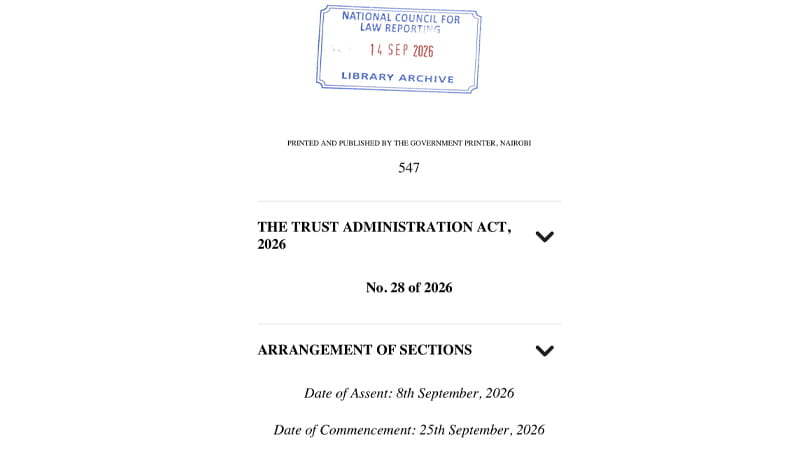
Kenya has enacted the Trust Administration Act, 2026 (Act No. 28 of 2026), introducing a comprehensive legal framework for the creation, registration, incorporation, management and regulation of trusts and trustees.
The Act was assented to on 8th September 2026 and comes into force on 25th September 2026
.
Importantly, the new Act repeals both the Trustees (Perpetual Succession) Act (Cap. 164) and the Trustees Act (Cap. 167) and consolidates the law governing trusts under one framework.
For individuals and families using trusts for estate planning, succession and preservation of family wealth, as well as charitable organisations and existing trustees, the new law introduces significant governance and compliance requirements.
-
What is a Trust? — Sections 2, 3 and 4
Section 2 contains the principal definitions under the Act, including the meaning of a beneficiary, beneficial owner, settlor, trustee, trust deed and trust property.
Section 3 provides for the application of the Act, while section 4 sets out how a trust is created.
Under section 4, a trust is created where identifiable property or an interest in property is transferred to, vested in, or placed under the control of a trustee — or where an owner declares that property is held in trust.
The property must be held either for the benefit of one or more beneficiaries, a class of beneficiaries, or for the furtherance of a specified lawful purpose. A trustee must then be appointed to administer, control or dispose of the property in accordance with the trust deed, the law or a court order.
In practical terms, a trust creates a legal arrangement through which property is placed under the administration of a trustee for specified beneficiaries or a lawful purpose.
-
Written Trusts Must Be Registered or Incorporated — Section 5
Section 5 makes an important distinction between written and implied trusts.
Although a trust may be written or implied, a written trust must be registered or incorporated in accordance with the Act.
Further, a written trust is generally not enforceable unless it has been registered or incorporated under the Act and in accordance with the terms of its trust deed.
Where a person claims an interest under a written trust that has not been registered or incorporated, that person may apply to court for recognition or enforcement of the trust.
Formal registration or incorporation is therefore an important part of establishing and operating a written trust under the new regime.
-
When Can a Trust Be Invalid? — Sections 6 and 7
Section 6 provides circumstances in which a trust may be declared invalid. These include where the trust is created for an illegal purpose, where there is no identifiable or ascertainable beneficiary unless it is a non-charitable purpose trust, where it was established through fraud, duress or misrepresentation, where its terms are too uncertain to perform, or where the settlor lacked legal capacity.
The Court may also declare a trust void where it is proved that it was created for fraudulent purposes, including to evade the settlor’s creditors.
Importantly, the mere bankruptcy of the settlor, liquidation of the settlor’s property or proceedings by creditors does not by itself render a trust void.
Under section 7, a trust is deemed to be irrevocable unless the trust deed expressly contains a power of revocation.
This makes the drafting of the trust deed particularly important.
-
What Types of Trusts Does the Act Recognise? — Sections 8, 9 and 10
The Act expressly provides for several types of trusts.
Section 8 — Charitable Trusts
The Act recognises trusts established for charitable purposes.
Section 9 — Non-Charitable Purpose Trusts
The Act also recognises trusts established for specified lawful non-charitable purposes.
Section 10 — Family Trusts
Of particular significance for estate and succession planning is the express statutory recognition of the family trust.
A family trust may be living or testamentary and may be established by one or more persons for purposes of planning or managing their personal estate.
The Act provides that a family trust may be established for the preservation or creation of wealth for generations and must be a non-trading entity.
The intended beneficiaries do not necessarily have to be related to the settlor, and the settlor or joint settlors may themselves be beneficiaries of the family trust.
For families considering succession and intergenerational wealth planning, section 10 therefore provides an important statutory foundation for the use of family trusts.
-
How Many Trustees Are Required? — Section 11
Section 11 deals with the number of trustees required for the different types of trusts.
A charitable trust or non-charitable purpose trust must have at least three natural persons as trustees or one corporate trustee.
A family trust requires at least one trustee.
Where trustees are natural persons, at least one must be a Kenyan citizen or resident of Kenya, subject to the Regulations.
-
The Settlor Can Retain Certain Powers — Sections 12 and 13
The person establishing the trust is known as the settlor.
Section 12 deals with the settlor, while section 13 addresses the powers that may be retained by the settlor.
Subject to the trust deed and applicable law, these may include powers relating to amendment or variation of the trust; advancement or distribution of trust income or capital; management, purchase, sale, lending, pledging or charging of trust property; appointment or removal of trustees, enforcers or beneficiaries; and appointment or removal of a trust agent.
The settlor may also restrict the exercise of certain powers or discretions by trustees.
The precise powers retained by a settlor will therefore depend substantially upon the manner in which the trust deed is drafted.
-
Who is an Enforcer? — Sections 14 to 18
Sections 14 to 18 introduce and regulate the role of an enforcer.
An enforcer may be appointed in accordance with the Act and the trust deed to provide oversight over the administration of the trust.
The enforcer’s functions may include enforcing the terms of the trust deed, monitoring implementation of the trust, requiring trustees to remedy breaches, reporting financial or other breaches and pursuing proceedings against trustees where appropriate.
The enforcer is also entitled to access documents, accounts and information necessary for the performance of the role.
This can provide an additional layer of oversight, particularly where substantial assets are being held for beneficiaries over a long period.
Sections 19 to 21 separately deal with beneficiaries, classes of beneficiaries and the disclaimer of a beneficiary’s interest.
-
Registration of a Trust — Sections 22 to 27
Sections 22 to 27 establish the framework for the registration of trusts.
They deal with the application for registration, the required contents of a trust deed, issuance of a Certificate of Registration, circumstances in which registration may be refused or revoked and the legal effect of registration.
The trust deed therefore becomes a central governance document under the new statutory framework.
-
Registration and Incorporation Are Not the Same — Sections 28 to 33
This is an important distinction under the new Act.
While sections 22 to 27 deal with registration, sections 28 to 33 govern incorporation.
In particular, section 32 provides that from the date of incorporation, a trust becomes a body corporate capable of:
- having perpetual succession;
- suing and being sued;
- acquiring, owning, holding, developing and disposing of property in its own name; and
- doing such other acts as a body corporate may lawfully do.
Under section 33, a trust that was initially registered may subsequently apply for incorporation. Upon incorporation, it ceases to exist merely as a registered trust and becomes a body corporate.
The distinction between registration and incorporation should therefore be considered carefully when establishing a trust intended to own land, investments or other substantial assets.
-
Trust Property — Sections 34 and 35
Under section 34, trustees must deal with and manage trust property in accordance with the trust deed unless otherwise authorised by the deed, a court or written law.
Section 35 provides that property acquired illegally or through unlawful means cannot form part of trust property and may be subject to recovery or forfeiture under applicable law.
A trust cannot therefore be used as a mechanism for insulating unlawfully acquired property.
-
Appointment, Resignation and Removal of Trustees — Sections 36 to 42
Sections 36 to 42 regulate trustees themselves.
These provisions address qualifications and disqualifications, appointment of trustees, appointment of substitute or additional trustees, resignation, removal, death or dissolution of a trustee and the effect of a change in trustees.
Importantly, section 42 provides that a change in trustees does not affect the existence, rights or obligations of the trust.
-
Trustees Have Express Statutory Duties — Sections 43 to 49
The Act imposes extensive duties upon trustees.
Under section 43, a trustee must exercise reasonable care, skill and diligence. A trustee is also required to know and comply with the trust deed, act honestly and in good faith, act for the benefit of beneficiaries or the lawful purpose of the trust, avoid conflicts of interest and treat beneficiaries impartially where appropriate.
Section 44 requires trustees to act within their powers.
Section 45 addresses the duty not to profit improperly from trusteeship.
Section 46 requires trustees to preserve trust property.
Section 47 requires trust property to be kept separate from the trustee’s own property. Trust bank accounts and investments must therefore be identifiable as belonging to the trust.
Sections 48 and 49 deal with record-keeping and access to information.
-
What Powers Do Trustees Have? — Sections 50 to 59
While imposing substantial duties, the Act also grants trustees powers necessary to administer trust property.
Sections 50 to 59` include powers relating to maintenance and accumulation of income during minority, management and control of trust property, delegation, appropriation, sale and lease, borrowing, distribution of trust property, commencement or settlement of claims, powers of attorney and insurance.
The exercise of these powers remains subject to the Act and the terms of the particular trust deed.
-
Trustee Remuneration and Liability — Sections 60 to 62
Section 60 deals with trustee remuneration and expenses.
A trustee may receive remuneration where authorised by the trust deed, written consent of every beneficiary or an enforcer, a court order or another written law. Proper expenses and liabilities incurred in connection with the trust may also be reimbursed from trust property in the circumstances permitted by the Act.
Section 61 deals with liability for breach of trust.
A trustee who commits or participates in a breach may be liable for losses or depreciation in trust property and profits that would otherwise have accrued to the trust.
The Act additionally provides for administrative penalties of up to KSh 1 million for an individual trustee and KSh 5 million for a corporate trustee.
Under section 62, a trust deed cannot exclude liability arising from a trustee’s dishonesty, wilful misconduct or gross negligence.
Trustees therefore assume real legal responsibilities when accepting appointment.
-
Trust Records and Accounts — Sections 63 and 64
Section 63 requires trusts to maintain specified records, including their certificate of registration or incorporation, trust deed and amendments, information relating to the settlor, trustees, beneficiaries, enforcers and beneficial owners, and a list of trust property.
The relevant records must generally be retained for at least seven years.
Section 64 separately requires trusts to maintain proper accounting records capable of explaining transactions and showing the financial position of the trust with reasonable accuracy.
Accounting records must similarly be retained for at least seven years.
-
Beneficial Ownership — Sections 65 to 69
The Act introduces express beneficial ownership obligations for trusts.
Under section 65, every trust must compile and maintain a register of its beneficial owners.
Under section 66, the trust must lodge a copy of that register with the Registrar.
Trusts incorporated before commencement of the Act must lodge their beneficial ownership registers within 24 months after the Act comes into force, although the Registrar may extend that period.
Under section 67, changes to beneficial ownership must be updated and lodged with the Registrar within 21 days.
Failure to comply may attract administrative penalties and continued breach can ultimately result in disqualification of trustees under section 69.
-
Annual Returns — Section 75
Trust administration does not end once a trust has been registered or incorporated.
Under Under section 75, every trust must file an Under annual return with the Registrar within 30 days of the anniversary of its registration or incorporation.
Failure to comply attracts an administrative penalty of Under KSh 3,000 for each year of default.
Trusts will therefore require ongoing statutory compliance.
-
Advocates Can Act as Trust Agents — Section 76
Section 76 formally recognises the role of a trust agent.
A trust agent may provide services relating to trust formation and setup, advisory services, preparation of registration or incorporation documents, compliance with relevant laws and regulations, provision of a registered office address for a family trust and lodging statutory documents.
For the statutory functions specified by the Act, a trust agent must be an Advocate of the High Court of Kenya, Certified Secretary or Certified Accountant.
The Act expressly preserves the requirement that documents required by law to be drawn by an advocate cannot be drawn by an unqualified person.
Trust agents are also required to maintain specified records for at least seven years.
-
The Registrar of Trusts — Sections 77 to 83
Section 77 establishes the office of the Registrar of Trusts within the Business Registration Service.
The Registrar is responsible for establishing the Registry and maintaining the Register of Trusts.
Sections 78 to 83 further address the Register, the Registrar’s functions and directives, electronic lodgment of documents, the Registrar’s official seal, rectification and applicable fees.
This places the administration and regulation of trusts within a more centralised statutory framework.
-
Dissolution of a Trust — Sections 84 to 89
Sections 84 to 89 provide the framework for dissolution and restoration of trusts.
Upon dissolution, section 89 provides that trust property must be dealt with according to the trust deed or applicable law.
Where the trust deed does not provide for the treatment of property upon dissolution, the Court may determine how the property should be dealt with.
The Act also provides mechanisms for restoration of a dissolved trust, including restoration by the Registrar where dissolution resulted from the Registrar’s mistake and restoration by the Court in appropriate circumstances.
This underscores the importance of ensuring that a trust deed contains clear provisions on what happens to trust property when the trust comes to an end.
-
Electronic Filing, Data Protection and False Information — Sections 90 to 93
Under section 90, filings required by the Act may be made electronically and statutory records may be maintained electronically.
Section 91 expressly requires persons processing personal data under the Act to comply with the Data Protection Act.
Under section 92, knowingly lodging materially false or misleading information with the Registrar is an offence punishable by a fine of up to KSh 1 million, imprisonment for up to two years, or both.
Section 93 provides a general penalty of up to KSh 1 million where the Act creates an offence but does not prescribe a specific penalty.
-
How Will Trust Disputes Be Resolved? — Section 94
The wording of the trust deed is also important when disputes arise.
Under section 94, a dispute concerning a trust is to be determined in accordance with the dispute resolution mechanisms contained in the trust deed.
Where the trust deed does not prescribe a dispute resolution mechanism, the dispute is to be determined by the High Court.
A carefully drafted dispute resolution clause should therefore form part of a properly structured trust deed.
-
What Happens to Existing Trusts? — Section 99
This is one of the most important provisions for persons who already have trusts.
Under section 99(1), the Act repeals the Trustees (Perpetual Succession) Act and the Trustees Act.
However, existing trusts do not cease to exist.
Under section 99(2), trusts previously incorporated under the Trustees (Perpetual Succession) Act and trusts created through registration of a deed under the Registration of Documents Act are deemed to be trusts under the new Act.
Crucially, all existing trusts must comply with the requirements of the Trust Administration Act within 24 months after the Act comes into effect, or within such other period as the Registrar may direct.
Under section 99(3), the Registrar may also issue new certificates of incorporation to trusts incorporated under the previous regime and recall certificates issued under the repealed Trustees (Perpetual Succession) Act.
Existing trustees and settlors should therefore review their trust deeds, beneficial ownership information, records, governance arrangements and compliance structures during the transition period.
What Does the Trust Administration Act, 2026 Mean for You?
The Trust Administration Act, 2026 significantly formalises trust administration in Kenya.
For anyone considering establishing a trust, the new framework makes the structure and drafting of the trust deed particularly important. Decisions must be made about whether the trust should merely be registered or incorporated, who should serve as trustees, what powers the settlor should retain, whether an enforcer should be appointed, how assets should be managed and distributed, and what should happen upon dissolution.
For families, section 10 on family trusts is particularly significant. It expressly provides a legal structure that may be used for estate planning and management and the preservation or creation of wealth across generations.
For existing trusts, section 99 should not be overlooked. Existing trusts have a statutory transition period within which they must comply with the new regime.
At P. A. Kwega & Co. Advocates, we advise individuals, families, trustees and organisations on the establishment, structuring and administration of trusts, including:
- Family trusts and intergenerational wealth planning;
- Estate and succession planning;
- Drafting and review of trust deeds;
- Registration and incorporation of trusts;
- Review and restructuring of existing trusts; and
- Ongoing trust governance and statutory compliance.
Disclaimer: This article is intended for general information purposes only and does not constitute legal advice. Legal advice should be obtained based on the particular circumstances of each matter.






 Call or Chat with us