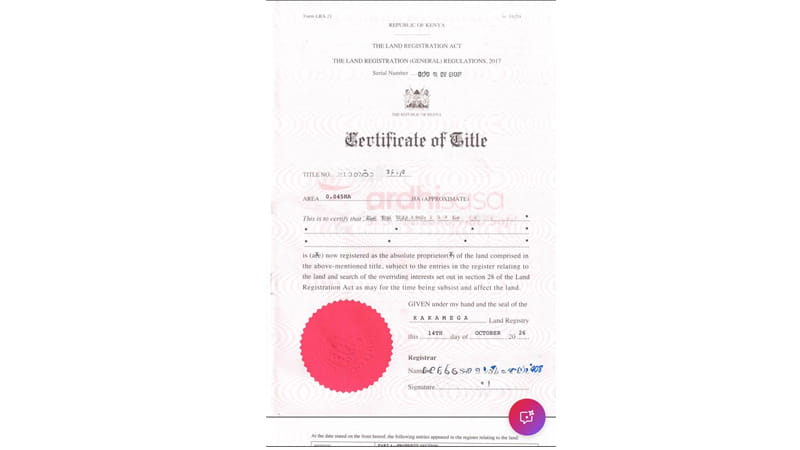
A title deed is important. But it is not enough to guarantee that the land you are purchasing is legally sound.
Purchasing land is one of the most significant financial decisions an individual or business can make. Whether you are buying land to build a family home, develop commercial property, invest or secure your family’s future, the expectation is that your investment will be safe.
Unfortunately, land transactions in Kenya can present significant legal risks. Cases involving fraudulent titles, double allocations, disputed boundaries, undisclosed encumbrances and unlawful transfers are not uncommon.
One of the most expensive mistakes purchasers make is assuming that possession of a title deed, or even a clean official search, automatically guarantees a secure investment.
Before you sign a sale agreement or pay a deposit, there are important legal checks you should undertake.
-
Establish Who Is Selling the Property
The first question is not necessarily whether the land exists, but whether the person offering it for sale has the legal authority to sell it, I.e the identity, ownership and legal capacity of the seller.
This includes verifying that:- The vendor’s identification documents correspond with the registered ownership particulars.
- The vendor is legally entitled to dispose of the property.
- Where the vendor is a company, the company has properly authorised the transaction through the requisite corporate approvals.
- Where the vendor acts through an attorney, the power of attorney is valid and authorises the proposed transaction.
- Where the property belongs to a deceased person’s estate, the personal representative has the necessary legal authority to sell it.
- The vendor is not subject to insolvency or other legal restrictions affecting the proposed disposal.
A person may possess an original title deed without necessarily having the legal authority to sale the property. The person selling the land must have both the legal right and the legal capacity to sell it.
-
Conduct an Official Search at the Lands Registry
An official land search is one of the fundamental steps in any property transaction. The search helps establish:
- The registered proprietor of the property.
- The parcel number and registered description.
- Whether the property is freehold or leasehold.
- Whether the property is subject to a charge, caution, restriction, prohibition or other registered encumbrance.
- Whether there are registered interests that may affect the proposed transfer.
Where the property is charged to a financial institution, for instance, appropriate arrangements must be made for discharge of the charge as part of the completion process.
However, an official search only reveals information contained in the relevant land register at the time of the search. It does not, by itself, establish that every previous transaction involving the property was lawful.
-
Investigate the History of the Title
A clean search today does not necessarily mean the property has a clean history. It may be necessary to examine the historical land register, commonly referred to as the Green Card, together with other available ownership records.
This helps establish how the property was acquired, whether previous transfers were properly undertaken and whether there are irregularities in the chain of ownership.
Where appropriate, investigations may also extend to historical public land allocation records, including the Ndung’u Commission Report. This is particularly important where there are concerns about irregular allocation of public land, unexplained changes in ownership or questionable subdivisions. A title deed is evidence of ownership, but the legality of its acquisition remains important.
-
Visit the Property and Verify Its Boundaries
An official search may confirm that a parcel exists in the land register, but it cannot confirm that the physical property shown to you corresponds with the registered parcel. A physical inspection should establish:
- Whether the land exists and corresponds with the title particulars.
- Whether the boundaries and beacons are correctly positioned.
- Whether there are encroachments by neighbouring properties.
- Whether the property is occupied by tenants, squatters or other third parties.
- Whether there are developments, access roads or physical features affecting its use.
Where necessary, engage a licensed surveyor to verify the boundaries against the relevant survey records.
-
Investigate Existing Disputes and Third-Party Claims
The property may be the subject of ongoing litigation involving ownership, succession, boundaries, occupation or competing beneficial interests. Undertake appropriate investigations to establish whether there are pending or previous legal proceedings affecting the property. Pay attention to:
- Ownership and succession disputes.
- Boundary and encroachment claims.
- Claims by spouses, beneficiaries or other persons asserting an interest in the property.
- Existing court orders restricting dealings with the land.
- Tenancies or occupation arrangements that may affect vacant possession.
-
Confirm Land Rates, Land Rent and Other Outstanding Obligations
Before completion, it is important to establish whether there are outstanding financial obligations attached to the property. Depending on the nature and location of the land, these may include unpaid land rates, land rent, penalties and other statutory liabilities.
-
Verify Land Use, Planning Restrictions and Public Interests
You may purchase land intending to construct apartments, establish a commercial development or build a residential home. However, not every parcel of land can lawfully be used for every intended purpose.
Before purchasing, establish whether the proposed development is consistent with the applicable planning framework. Relevant investigations may include zoning, approved land use, development permissions and applicable environmental or planning restrictions.
It is equally important to establish whether the property is affected by:
- Road reserves or proposed road expansions.
- Riparian reserves.
- Wayleaves and easements.
- Compulsory acquisition processes.
- Public utility infrastructure or other statutory interests.
-
Establish Whether Statutory or Third-Party Consents Are Required
Certain property transactions require specific consents or approvals before they can be lawfully completed. For example, controlled transactions involving agricultural land within a land control area are generally subject to the consent requirements under the Land Control Act. Where matrimonial property is involved, the applicable spousal consent requirements must also be considered. Failure to obtain a required consent may affect the validity, registrability or completion of the transaction.
-
Have an Advocate Review and Prepare the Sale Agreement
A properly drafted agreement should clearly address the purchase price, deposit, payment arrangements, completion period, obligations of the parties and documents required for completion. It should also provide appropriate safeguards concerning:
- The vendor’s representations and warranties.
- Existing encumbrances and their discharge.
- Vacant possession and occupation.
- Required statutory consents and approvals.
- Default, termination and refund of the deposit.
- Delays arising from title conversion, subdivision or registration processes.
- Dispute resolution.
-
Confirm Registration and Completion of the Transfer
Signing a sale agreement and paying the purchase price do not, by themselves, complete the transfer of registered ownership. An advocate should oversee the completion process, including verification of completion documents, payment of applicable stamp duty, obtaining necessary consents and registration of the transfer.
Once registration is completed, a post-registration search should be undertaken to confirm that the purchaser has been registered as proprietor and to verify the relevant register entries. Where the purchase is financed, the process should also account for the lender’s security requirements and registration of the applicable charge.
Why Engaging an Advocate Early Matters
A common misconception is that an advocate is only necessary when preparing or witnessing a sale agreement. In reality, the advocate’s role begins much earlier. A conveyancing advocate helps identify legal risks, investigate ownership, examine the relevant records, negotiate contractual protections and coordinate the legal aspects of completion. More importantly, an advocate can advise you when a transaction presents risks that require further investigation, renegotiation or withdrawal.
The cost of proper legal due diligence is often considerably less than the financial and emotional cost of purchasing disputed or unlawfully acquired land. Before you buy the land, establish what you are buying, who you are buying it from and whether the law protects the transaction.
At P. A. KWEGA & CO. ADVOCATES, we provide legal advisory and conveyancing services to individuals, investors and businesses undertaking property transactions in Kenya. Our services include property due diligence, title verification, preparation and review of sale agreements, transaction structuring, property transfers and representation throughout the conveyancing process.
Planning to purchase land or property in Kenya? Engage us before committing to the transaction.
Disclaimer: This article is intended for general legal information and does not constitute legal counsel.


 Call or Chat with us